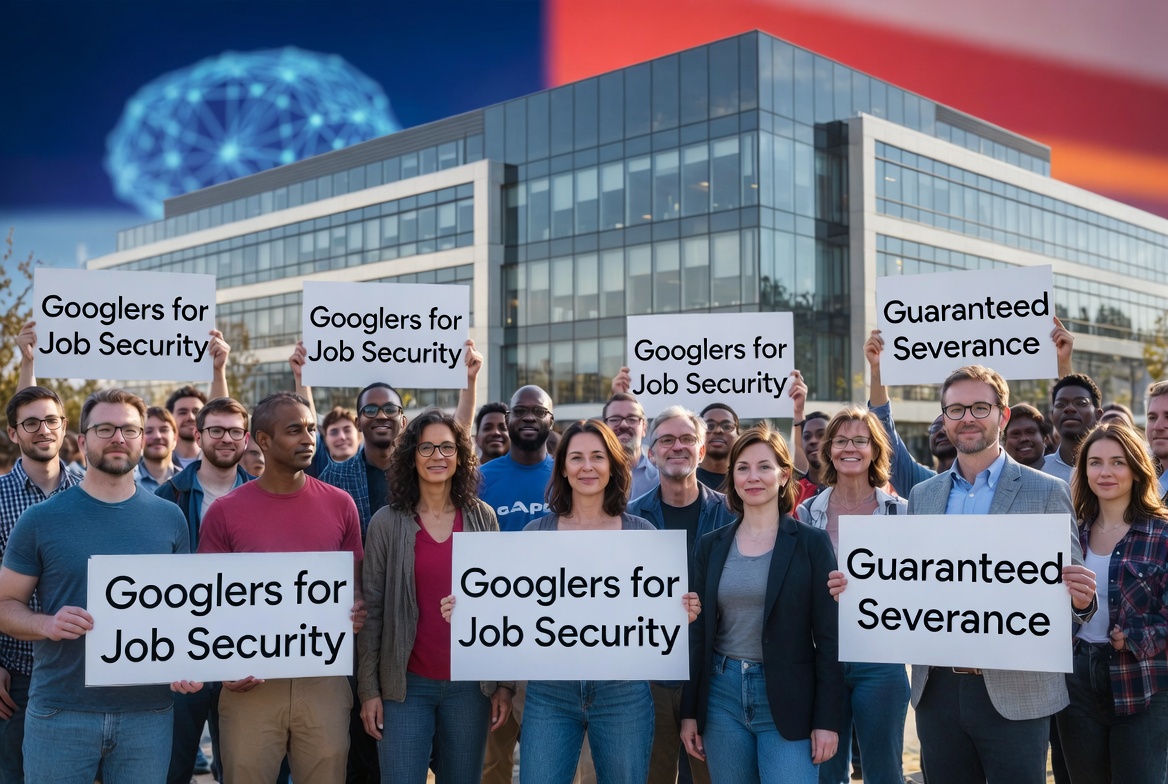
On July 16, 2026, nearly 100 Google employees gathered outside the Mountain View headquarters. They wore matching black shirts, held signs reading “Googlers for Job Security,” and unfurled a long banner listing more than 4,500 names.
The group delivered their petition to CEO Sundar Pichai’s office. Alphabet Workers Union president and software engineer Parul Koul addressed the crowd.“
Make no mistake: this is a company that is enjoying massive, unprecedented success,” Koul said, referencing Google’s roughly $4 trillion valuation.
The action comes as Google continues shifting resources toward AI while managing ongoing reorganization.
Table of Contents
- What Happened at the Rally
- The Four Core Demands
- Why This Is Happening Now
- Historical Context at Google
- How This Affects Developers
- Business and Startup Perspective
- Risks and Opportunities
- How Google Compares to Peers
- What Happens Next
- Should You Care?
What Happened at the Rally
Dozens of employees from offices across the U.S. showed up at noon on the grassy area between the Googleplex and visitor center. Many carried Alphabet Workers Union placards.
The petition, originally drafted in early 2025, has now collected more than 4,500 signatures — more than double the number from last year.
Koul and other organizers handed the document over and then spoke to the crowd. The protest stayed peaceful and focused on four specific policy changes.
Google has not issued a detailed public response to the latest delivery, though the company has previously offered voluntary exit packages to tens of thousands of employees after earlier organizing pressure.
The Four Core Demands
The petition asks Google to implement four changes:
- Guaranteed severance for every employee laid off, with clear minimum standards.
- Voluntary exit packages first — offer buyouts before any mandatory layoffs.
- End forced-distribution performance ratings (known internally as GRAD quotas) so evaluations reflect actual work rather than forcing a curve.
- Option to take severance as extended paid leave instead of a lump sum (especially valuable for visa holders who need more time on payroll).
These demands build on partial wins. Google has already rolled out voluntary exit packages (VEPs) to over 70,000 employees across multiple rounds, something the union credits to earlier organizing.
Why This Is Happening Now
Google, like the rest of Big Tech, has been aggressively reallocating headcount toward AI initiatives. That shift has involved multiple rounds of restructuring since the large 2023 layoffs.Employees see continued uncertainty even as the company reports strong financial results. High-profile AI talent has left for OpenAI, Anthropic, and startups, adding to internal anxiety.Performance management systems that force a distribution of ratings have long been a point of friction, especially when teams are under pressure to deliver AI features quickly.The union argues that clearer protections would reduce fear and let people focus on building.
Historical Context at Google
Google historically avoided large-scale layoffs. That changed in 2023 when the company cut about 12,000 roles.
Since then, smaller rounds and voluntary programs have continued as the company streamlines management layers and doubles down on AI.
The Alphabet Workers Union formed in 2021 and has grown to around 1,400 members. It operates as a pre-majority union without formal NLRB bargaining rights for the full workforce.
Previous campaigns led to the introduction of voluntary exit packages — a policy Google’s CEO has publicly credited to listening to employees.
How This Affects Developers
For individual engineers and product builders, the biggest issues are:
- Uncertainty around performance ratings and how AI-driven productivity metrics factor in.
- Visa holders who want more runway if they receive severance.
- The ability to exit on their own terms instead of waiting for potential cuts.
Many developers say the current environment makes long-term planning difficult, especially when teams are racing to ship AI features.
Clearer severance standards and voluntary options would give people more agency without forcing them into sudden job searches.
Business and Startup Perspective
From Google’s side, the company is trying to stay lean while investing heavily in AI infrastructure and talent.
Voluntary programs help reduce headcount without the full cost and morale hit of forced layoffs.
For startups and smaller companies, Google’s approach sets a benchmark. If a giant like Google moves toward more predictable severance and voluntary exits, it raises expectations across the industry.
Investors generally like cost discipline, but repeated rounds of uncertainty can hurt retention of top AI talent — the very people companies are fighting hardest to keep.
Risks and Opportunities
Risks:
- Continued talent attrition if protections lag behind what competitors offer.
- Lower morale and productivity if performance systems feel unfair.
- Potential legal or regulatory scrutiny if actions appear retaliatory against organizing.
Opportunities:
- Stronger retention of experienced engineers who value stability.
- A clearer signal that Google is willing to evolve its culture in response to employee input.
- Setting a higher standard that other tech companies may eventually follow.
How Google Compares to Peers
Other major tech firms have handled restructuring differently:
- Meta has done multiple large layoff rounds with relatively standard severance.
- Amazon and Microsoft have also used significant workforce reductions with varying support packages.
- Some smaller AI startups offer more aggressive equity acceleration or longer notice periods to attract talent from Big Tech.
Google’s voluntary exit packages already stand out as more generous than many peers. Formalizing the other demands in the petition would widen that gap further.
What Happens Next
The union says it will continue collecting signatures and organizing visibility actions. Google may respond with expanded voluntary programs or new policies around performance management.
Expect more internal discussions and possibly additional public actions if the company does not move quickly on the core requests.
Broader industry trends — continued AI investment, talent competition, and economic uncertainty — will keep job security top of mind for tech workers through the rest of 2026.
Should Readers Care?
Yes — especially if you work in tech, manage teams, or invest in the sector.Job security policies at a company the size of Google influence norms across the industry. They also directly affect how developers think about career stability while building AI products that are reshaping every sector.
For founders and product leaders, these issues shape hiring, retention, and team culture in an environment where AI is accelerating change faster than most organizations can adapt.
Key Takeaways
- Over 4,500 Googlers signed a petition for guaranteed severance, voluntary exits before layoffs, ending forced performance quotas, and severance as paid leave.
- The Alphabet Workers Union delivered the petition during a July 16 rally at Mountain View headquarters.
- Google has already introduced voluntary exit packages for tens of thousands of employees following earlier organizing.
- The demands come amid ongoing AI-driven restructuring and competition for top talent.
- Clearer protections could improve retention and morale while setting a higher industry standard.
Daily Brew Verdict
Impact Rating (out of 10)
- Developers: 8 — Directly improves day-to-day stability and career planning.
- Businesses: 7 — Helps retention but adds structure to cost management.
- Consumers: 5 — Indirect effects through product quality and innovation pace.
- Investors: 6 — Supports long-term talent retention in the AI race.
- Open Source / Broader Tech: 7 — Raises the floor for worker protections industry-wide.
The movement shows tech workers are organizing more effectively around job security as AI transforms roles and headcount strategies.
“The best teams treat their platform like a product, not a project.”
Get the next one in your inbox
Comments
Loading comments…

